Last updated: 13 October 2026 · By Wes Kennedy, Ag Equine Supplies
The quick answer
A good electric fence for horses comes down to five parts working together: an energiser sized for your fence, a proper earth, visible wire or tape, good insulators, and a tester to check it. Horses need to see the fence, so use tape, rope or sighter wire rather than plain wire alone. Most weak fences are an earthing or leakage problem, not a weak energiser. Never electrify barbed wire. Test the fence at the far end, not beside the energiser, and check it after storms, wind and growth. Fit warning signs anywhere it runs along a public road or path.
In this article
- What do you need for an electric fence for horses?
- Which electric fence energiser should you choose?
- Is tape, rope or wire better for horses?
- Why does earthing matter so much?
- How do you put the fence up?
- How do you test an electric fence?
- What are the safety rules in Australia?
- The bottom line
- Questions we're often asked
An electric fence for horses is one of the cheapest ways to divide a paddock, protect a boundary or keep a horse off a good fence line. It works because a horse learns to respect it after one or two contacts, then stays off it. That only holds if the fence carries a strong pulse every day, all the way to the far corner.
This guide covers what to buy, how the parts fit together, and the checks that keep it working. If you would rather talk it through for your property, get in touch and we will help you size it.
What do you need for an electric fence for horses?
Every electric fence has the same five parts. Get one wrong and the whole fence suffers.
| Part | What it does | Where to find it |
|---|---|---|
| Energiser | Sends a short, high voltage pulse down the fence about once a second | Energisers |
| Earth system | Completes the circuit through the ground so the horse feels the pulse | Earthing |
| Wire, tape or rope | Carries the pulse and gives the horse something to see | Wire, tape and rope |
| Insulators and posts | Hold the line up and stop the pulse leaking into posts | Hardware and insulators, Posts |
| Tester | Tells you what voltage is actually on the line | Testers |
Add insulated gate handles wherever you need to walk through.
Which electric fence energiser should you choose?
Start with the power source, then the size.
Mains, battery or solar
- Mains powered energisers are the strongest and most reliable when you have power near the fence line.
- Battery powered units suit paddocks away from power, and need the battery checked and charged.
- Solar electric fence energisers charge a battery from a panel, so they suit remote paddocks and strip grazing. Units with a built-in lithium battery, such as the Nemtek Agri Solar 5km Energizer, keep the setup to one box.
Many units, including the Nemtek Agri 20km Energizer, run on either battery or mains, which is handy if you move them between paddocks.
Reading the km rating
Energisers are sold by a distance rating, such as 5km, 20km or 50km. Treat that figure as a best case on a clean single wire. Every extra line, every bit of grass touching the fence and every weak insulator drains power. Count the total length of live wire, not the length of the paddock boundary, and buy with headroom. For horses specifically, Nemtek also makes the Equine 20km Energizer, built for horse fencing.
Is tape, rope or wire better for horses?
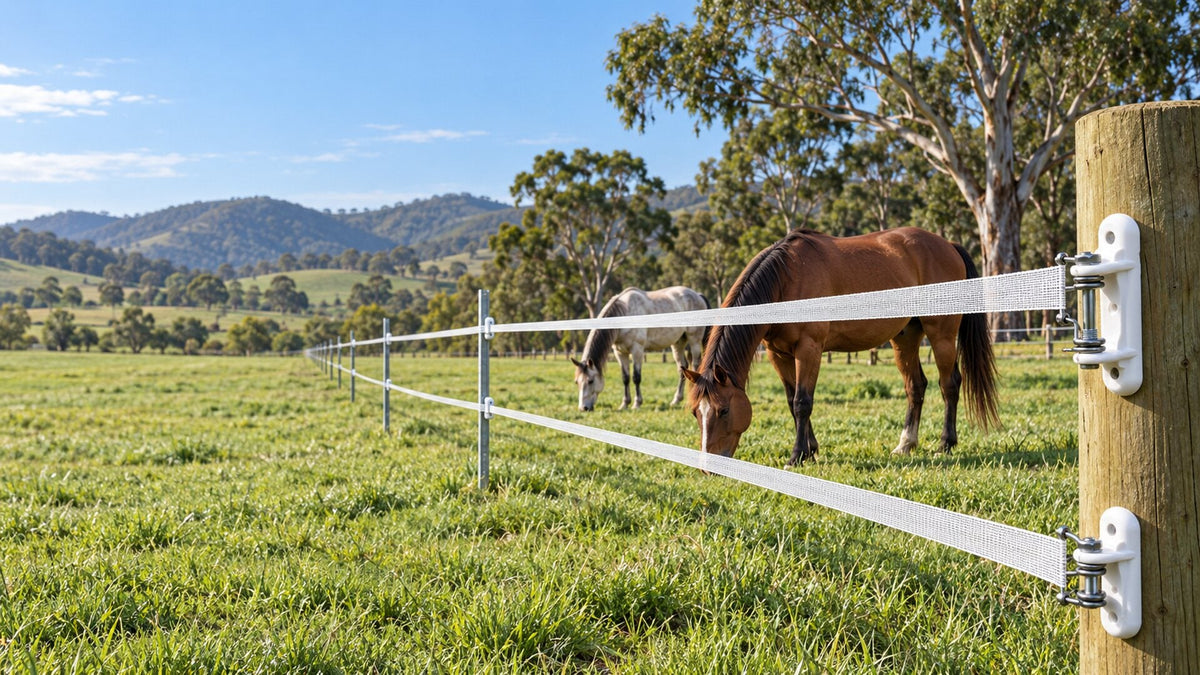
Horses need to see the fence. A thin plain wire is easy to miss, especially at a gallop, so most horse owners use something wider or more visible.
| Option | Best for | Watch out for |
|---|---|---|
| Electric fence tape | High visibility, temporary paddocks and strip grazing | Wide tape catches wind; keep it tensioned so it does not flap and fray |
| Rope (such as Nemtek Flexi Rope) | Permanent horse paddocks; stronger and handles weather better than tape | Needs insulators sized for rope |
| Sighter wire | Adding a visible line to an existing fence | Still thinner than tape, so pair it with a visible top line |
| Plain wire | Long runs and offset lines on existing fences | Low visibility on its own; not ideal as the only line for horses |
Why does earthing matter so much?
The pulse travels down the fence, through the horse, into the ground and back to the energiser through the earth stakes. If the earth is poor, the horse feels very little, no matter how strong the energiser is.
In our experience, a weak earth is the most common reason a fence "isn't working". Use galvanised earth stakes driven deep into ground that stays damp, spaced out from each other, and follow the earthing instructions for your energiser. A kit such as the Nemtek Super Earth Kit gives you matched parts. Keep the earth well away from water pipes, power earths and telephone earths.
In dry summers, or on sandy or rocky ground, you may need more stakes, or an earth return wire run along the fence.
How do you put the fence up?
- Plan the layout. Walk the line, mark the corners, gates and where the energiser and earth will sit.
- Set corner and strainer posts first. They take the tension. Line posts go in between.
- Fit insulators. Every point where a live line meets a post needs an insulator. A cracked insulator leaks power into the post.
- Run the line. Keep it tensioned so it does not sag to the ground or touch posts.
- Fit gates. Use insulated gate handles so you can open the gap without switching off.
- Connect the energiser and earth. Use leadout cable rated for electric fences.
- Clear the line. Grass, branches and weeds touching the fence drain voltage, so keep the line clear.
Introduce horses carefully. Lead them up to the fence in daylight so they can see it before they touch it, and make sure the paddock has room for a horse to move away once it gets a shock.
How do you test an electric fence?
An electric fence tester is the only way to know what is on the line. A light on the energiser only tells you it is switched on. A simple unit such as the Nemtek Fence Tester Easy does the job for most paddocks.
- Test at the far end. The reading beside the energiser will always look good. The far corner tells the truth.
- Test the earth too. Your energiser instructions will explain how to check the earth system under load.
- Find faults faster. A directional fault finder, such as the Nemtek Directional Fault Finder and Fence Meter, shows which way current is leaking so you are not walking the whole line.
- Test on a schedule. After storms, strong wind, a horse going through, or a growth spurt in spring.
For larger properties, remote monitoring tools such as the Nemtek Agri Remote let you check and switch the fence without walking to it.
What are the safety rules in Australia?
Electric fence installations in Australia fall under AS/NZS 3014. Two rules matter for most horse owners:
- Never electrify barbed wire or razor wire. You can run an offset electric line along a barbed wire fence, held at least 150mm away from it on offset brackets.
- Fit warning signs at regular intervals anywhere the fence runs along a public road or pathway. The standard sets a yellow sign of at least 100mm by 200mm, with lettering on both sides.
Check your state and council rules as well, as some add their own requirements, and always follow the manufacturer's instructions for your energiser.
The bottom line
A strong electric fence for horses is a system: a properly sized energiser, a deep earth, a line horses can see, good insulators and regular testing. Get the earth right and keep the line clear, and most fence problems never happen.
Browse our full range of electric fencing supplies, or contact us to size an energiser for your property. Keeping horses comfortable in the paddock over summer? Read our guide to fly masks and fly veils.
Questions we're often asked
What is the best electric fence for horses?
The best electric fence for horses uses a visible line such as tape or rope, a properly sized energiser and a good earth system. Horses need to see the fence, so wide tape or rope is usually a better choice than plain wire on its own.
How big an energiser do I need for horses?
Choose an energiser rated well above the total length of live wire, not just the paddock boundary. Distance ratings are best case figures, and grass, extra lines and leakage all reduce what reaches the far end of the fence.
Is solar electric fencing strong enough for horses?
Yes, a correctly sized solar energiser can run a horse fence well, especially in remote paddocks. Size the unit and battery for your fence length, and keep the panel clean and facing the sun.
Why is my electric fence not working?
The most common causes are a poor earth, vegetation touching the line, a cracked insulator or a break in the wire. Test at the far end of the fence, then work back toward the energiser to find the fault.
Can you electrify barbed wire for horses?
No. Under AS/NZS 3014, barbed wire and razor wire must not be electrified. An electric line can be run on offset brackets along a barbed wire fence, at least 150mm away from it.
About the author
Wes Kennedy writes for Ag Equine Supplies.
Sources
- Standards Australia, AS/NZS 3014:2003 Electrical installations: Electric fences
- Nemtek product range as stocked by Ag Equine Supplies